
Whole Life Is Not Whole Life – Why Policy Design Matters in Executive Benefit Funding
Boards reviewing executive benefit arrangements often approach whole life insurance as if it were a uniform product. The discussion typically centers on carrier strength, dividend history, projected policy values, and long-term performance expectations.
What is far less frequently examined is policy structure.
Two policies described generically as “10-Pay whole life” can produce materially different results, even when issued by the same large, highly rated mutual insurer and funded with the same annual premium commitment.
Understanding why requires separating product itself from how the policy is actually structured.
Policy performance is sensitive to timing, structure, and assumptions. Long-term outcomes will ultimately depend on future dividend experience driven by mortality, expenses, and investment returns, none of which can be known in advance.
What can be controlled at the outset is policy design.
Same Commitment, Different Architecture
The impact of design becomes clear when isolating a single variable: how premium is allocated within the policy. To isolate structural impact, consider two 10-Pay whole life policies funded at $300,000 annually for ten years, issued on the same insured by the same insurer.
The only variable changed was premium allocation.
- Design A: 100% Base Whole Life
- Design B: Blended Whole Life (Base + Term + Paid-Up Additions via rider structure)
Insurers itemize the portion of premium used for acquisition load allocation separately from the total premium, commonly referred to as Target Premium (TP). By changing the structure of a policy at inception, the TP can be lowered as shown below.
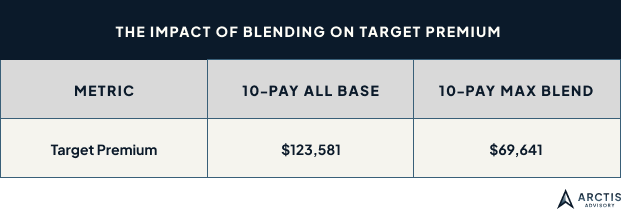
That is a 44% reduction in Target Premium exposure, despite identical total premiums.
This is accomplished by changing the policy structure and, with it, the internal premium allocation. One common design approach is “blending,” where a portion of the premium is allocated to a paid-up additions rider (PUAR) rather than the base policy.
Paid-up additions (PUAs) are small, fully funded pieces of whole life insurance that immediately increase both cash value and death benefit. Because they carry significantly lower acquisition costs than the base policy, they are not subject to the same commissionable target exposure.
Shifting premium into the PUAR reduces that exposure, lowers early internal loads, and improves cash value from the start, all without changing the total premium paid.
The effect of this change is visible immediately and compounds throughout the policy period.
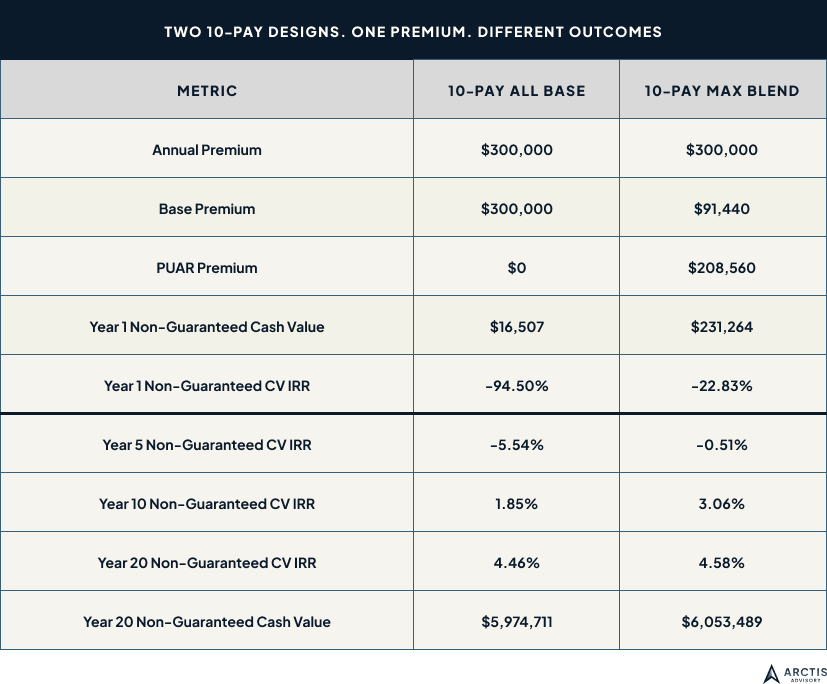
The difference is structural rather than performance-driven, as both policies are issued by the same insurer and funded with the same premium commitment.
For boards overseeing executive benefit plans, Year 1 is not theoretical. Executive arrangements introduce employment risk, separation risk, redesign risk, and liquidity considerations. A structure that retains little to no cash value after the first premium payment presents a materially different exposure profile than one that retains over $225,000.
Addressing a Common Assumption About Guarantees
A common assumption in policy design discussions is that allocating more premium to base coverage strengthens guarantees. To evaluate that claim, the comparison above was repeated assuming no non-guaranteed dividends are credited, isolating guaranteed values only.
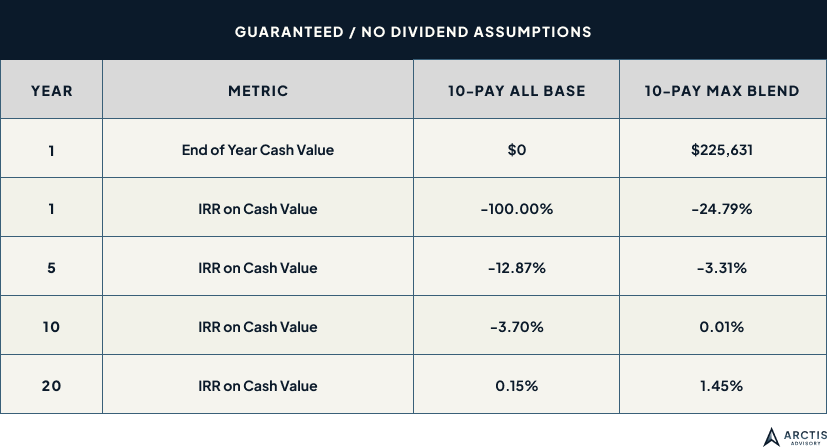
Even when dividend assumptions are removed, the structural divergence persists. The blended 10-Pay design reaches breakeven during the funding period; the all-base design does not.
This does not guarantee superior long-term performance. But it does mean that policies retaining more value early begin compounding from a stronger position, increasing the probability of more favorable long-term outcomes.
Boards cannot control future dividend experience. They can require structural efficiency at policy inception.
Funding Compression: 10-Pay vs 7-Pay
The comparison above holds funding duration constant to isolate the impact of premium architecture. Duration itself is a second structural variable, one that can also materially affect policy performance.
Using the same blended architecture, funding was modeled across two schedules: a 10-Pay structure and a 7-Pay structure.
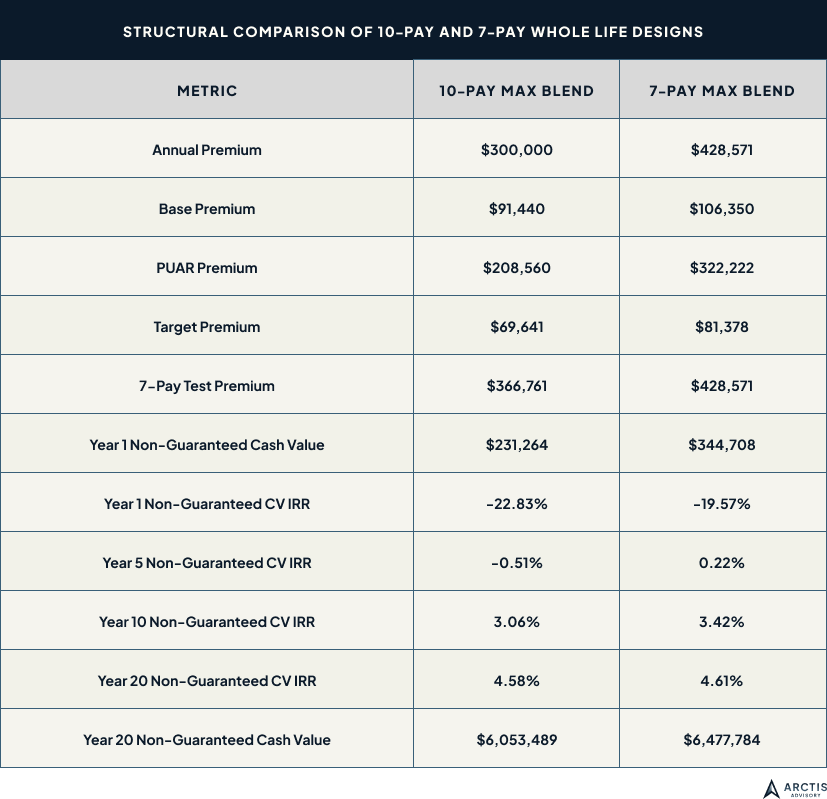
Compressing the funding period into fewer years accelerates early cash value accumulation and, in the example above, moves the blended design to breakeven within the funding period itself. It also raises the MEC threshold, the regulatory ceiling on how quickly a policy can be funded. A higher threshold creates additional capacity for PUAR premium. However, accommodating a shorter pay period requires a larger initial face amount, which partially offsets the blending benefit on the commissionable target. In the comparison above, the Target Premium increases from $69,641 on the 10-Pay blended design to $81,378 on the 7-Pay. These variables do not move in a single direction. The compensation implications of each are present in the illustration, but rarely explained in the context of design discretion.
Because funding compression moves annual premiums closer to the MEC limit, prudent policy construction typically includes a modest cushion below that threshold to avoid inadvertently triggering MEC status, a classification that changes how policy distributions are taxed.
There is an additional structural benefit to higher PUAR allocation that is relevant to executive benefit arrangements specifically. PUAR premiums are discretionary. They are not contractually required to keep the policy in force. If an executive departs and the company wishes to reduce or discontinue funding, the base premium can be maintained independently. A design weighted heavily toward base coverage does not offer the same flexibility, as the full base premium is required to prevent lapse. For boards managing employment risk and separation risk, this optionality has real value that does not appear in an illustration.
A Note on Distribution Phase
The comparisons in this analysis reflect accumulation-phase behavior only, assuming no loans, withdrawals, or premium offsets. Once distributions begin, a separate set of variables enters the picture.
Policy loans carry their own interest rate risk. Some carriers offer fixed contractual loan rates; others offer adjustable rates tied to market benchmarks. When loans are utilized, the spread between the borrowing rate and credited policy performance becomes a material factor, one that can compress or expand the effectiveness of loan-based distribution strategies independent of how well the policy was structured at issue.
In some arrangements, third-party lending secured by the policy is used in place of or alongside carrier loan provisions. Because third-party lenders operate outside the policy contract, their rates and terms can differ materially from what the carrier offers, sometimes favorably. This introduces an additional variable that affects distribution outcomes and warrants separate evaluation when income or liquidity strategies are being modeled.
Premium architecture and loan rate provisions should therefore be evaluated together when executive benefit plans anticipate policy loans or income streams. The structure selected today determines the foundation. How cash value is accessed, whether through withdrawals, policy loans, or a combination, determines how much of it the client keeps and what risks they carry in the process.
Governance Implications
Whole life insurance is often presented as a product decision. It is also a structural decision.
Premium allocation and funding duration meaningfully alter:
- Early available cash value
- Performance trajectory
- Liquidity exposure
- Premium flexibility and the company’s ability to reduce funding after a separation event
- Collateral profile in split-dollar arrangements, where policy cash value secures employer advances
- Break-even timing (IRR crossover)
Two policies labeled identically can behave very differently.
Boards evaluating executive benefit funding should require clarity on:
- Target Premium
- Early total cash value under both guaranteed and current assumptions
- Funding compression effects
- PUAR allocation and the discretionary nature of those premiums
- Loan rate provisions, including whether third-party lending arrangements are available or anticipated
Carrier strength and dividend history matter. But they do not substitute for structural review.
Whole life is not simply whole life. Design determines trajectory. And trajectory determines risk.
Alexander Bebis
Owner / President
Author
Alexander Bebis is an independent executive benefit consultant focused on the governance, design, and oversight of non-qualified benefit arrangements for credit unions and nonprofit organizations. His work centers on helping boards and leadership teams evaluate structure, assumptions, and long-term economic tradeoffs in executive
benefit plans.
Need Independent Insight?
Contact us at: (508)-972-8523 or info@arctisadvisory.com
Not every situation requires an advisor.
Tell us what is in front of you and we will tell you whether you need us.
