
Who Bears the Risk – A Framework for Evaluating Split Dollar Structures
Collateral assignment split dollar has become one of the most widely used executive retention tools in credit unions and nonprofits. The accounting treatment (a loan receivable rather than compensation expense) is a genuine structural advantage. But it has also become a distraction from a more important question.
When policy performance lags, or the cash surrender value falls below the outstanding loan balance, the accounting label on the asset doesn’t determine who absorbs the loss. The design of the arrangement does. Specifically, how it handles collateral, borrowing limits, and what happens when an executive walks out the door.
Boards that evaluate these arrangements primarily through an accounting lens are asking the right question about the wrong thing. The more useful question is direct: when performance diverges from projections, who actually bears the downside?
The answer varies significantly across structures that often carry similar labels.
Risk Allocation Framework
HOW COMMON SPLIT DOLLAR STRUCTURES ALLOCATE CREDIT, PERFORMANCE, AND DURATION RISK
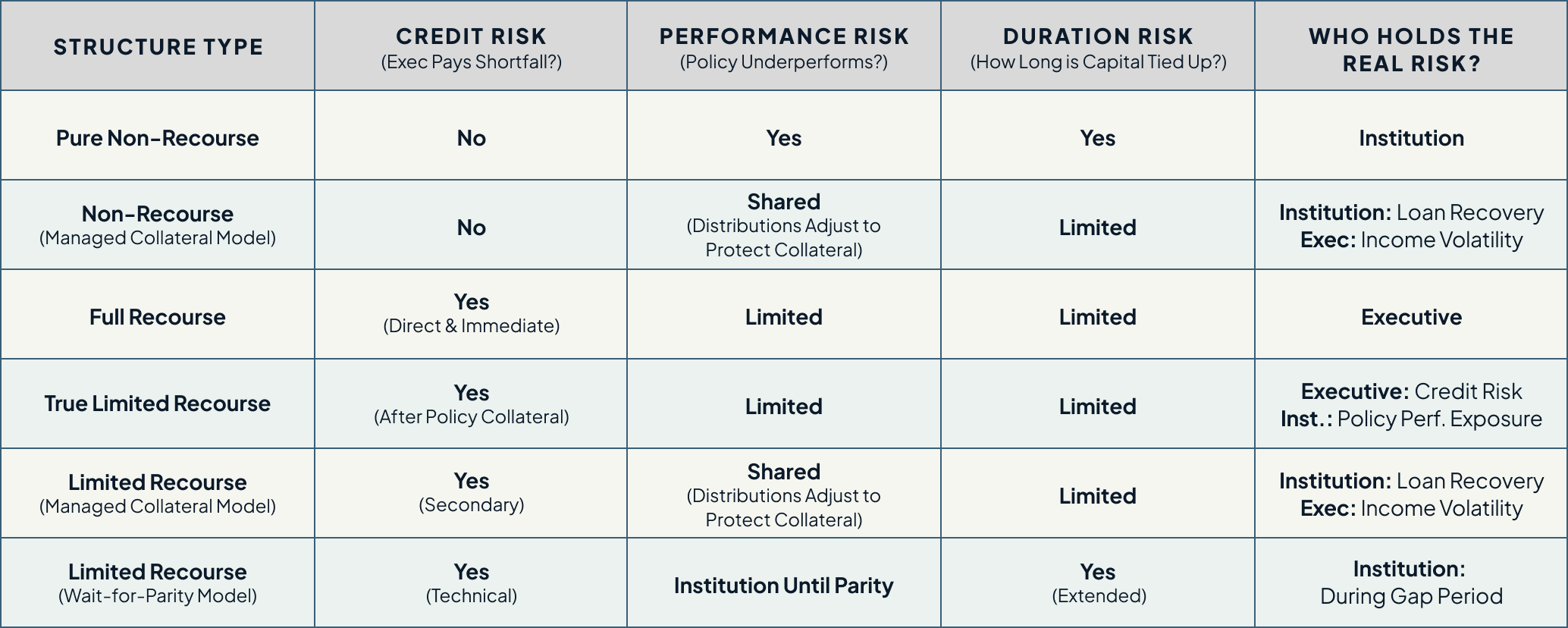
While these structures may appear similar on paper, the way they behave under stress is very different. Structures that look nearly identical in legal form can produce very different economic outcomes. The operational mechanics (borrowing caps, collateral monitoring, termination provisions) are where risk actually lives.
Pure Non-Recourse
In a pure non-recourse structure, the policy is the only source of repayment. If its value falls short of the outstanding loan balance at termination or death, the executive owes nothing further. The institution absorbs the gap. It is worth noting that if the death benefit is insufficient to repay the loan and the institution forgives the deficiency, the forgiven amount may constitute cancellation of debt income to the executive’s estate.
This has direct accounting implications. Independent audit guidance has been clear that when a loan is truly non-recourse, the receivable may need to be carried at the policy’s cash surrender value rather than the full loan balance, because there is no other realizable claim. The institution also bears duration risk: if the policy underperforms, it may need to hold the arrangement longer than projected while waiting for values to recover.
Non-Recourse – Managed Collateral Model
Some non-recourse arrangements layer in operational controls that meaningfully change the risk profile, even though the legal structure remains non-recourse. Common provisions include:
- Annual borrowing caps tied to current policy performance
- Periodic in-force reviews to test whether projections remain on track
- Restrictions on withdrawals that would impair the death benefit needed to repay the loan
The practical effect is that when a policy underperforms, the first consequence isn’t a loss to the institution. It’s a reduction in what the executive can take out. Retirement distributions shrink. The policy’s collateral position is preserved.
The executive’s retirement income becomes the arrangement’s primary shock absorber, a tradeoff that is not always surfaced clearly at inception.
The institution remains protected on loan recovery. The executive accepts income variability.
Full Recourse
Full recourse places the credit risk squarely on the executive. If the policy value is insufficient at repayment, the institution can pursue the deficiency directly from the executive’s personal assets, not just the collateral.
This is the cleanest structure from the institution’s perspective, and it arguably supports the strongest case for carrying the receivable at full value. In practice, however, it is rare. Few executives in nonprofit or credit union settings are willing to accept unlimited personal liability tied to long-duration policy performance they do not control.
True Limited Recourse
True limited recourse occupies a specific middle position: the policy is exhausted first, and the executive is responsible for whatever remains. Unlike managed collateral structures (where recourse is technically present but practically backstopped by borrowing restrictions), true limited recourse relies on actual personal liability as the secondary repayment mechanism.
From an accounting standpoint, the existence of that secondary claim can support full carrying value of the receivable. But until a deficiency actually materializes, policy performance still drives the economics. The institution isn’t fully insulated. It simply has an additional collection avenue if values deteriorate far enough.
Limited Recourse – Managed Collateral Model
The managed collateral mechanic operates the same way described above, with one meaningful difference: the executive retains secondary personal liability for any deficiency that collateral preservation fails to prevent.
In practice, the borrowing caps and collateral monitoring are designed to ensure that recourse never becomes necessary. The plan adjusts before a deficiency can form. But the existence of that secondary liability changes the accounting picture: unlike a pure non-recourse structure, the receivable may be supportable at full carrying value because the institution has a claim beyond the policy itself.
This outcome is the arrangement working as designed, not a failure of it. That dynamic is worth understanding clearly before the structure is approved.
Limited Recourse – Wait-for-Parity Model
The wait-for-parity variation handles the gap between policy value and loan balance differently: it defers resolution rather than preventing the gap from forming. If the executive separates while the policy is underwater, the arrangement can remain open until cash surrender value catches up to the outstanding balance.
This avoids immediate loss recognition. But the institution continues to hold economic exposure during that gap period, absorbing policy performance risk while the clock runs. Legal recourse may exist on paper, but the institution is effectively waiting on the policy, not on the executive. That extended duration exposure is not always clear at inception.
Accounting Judgment Belongs with the Institution’s Auditors
The accounting treatment of these arrangements is sometimes shaped by plan design decisions, and the outcome is frequently presented to boards as settled before the institution’s own auditors have weighed in.
It shouldn’t be. Independent accounting firms including Doeren Mayhew and Marcum/CBIZ have both been explicit that accounting treatment must reflect the substance of the arrangement and the realistic expectation of repayment, not the label on the agreement.
Whether a receivable should be carried at face value or marked to the policy’s cash surrender value is a judgment the institution’s auditors need to make independently, with full information about how the arrangement actually operates.
Governance Considerations
Boards don’t need to master the mechanics of every structure variant. They do need to insist on honest answers to a short list of direct questions:
- If this policy underperforms, will the executive realistically repay the deficiency, or does that recourse provision exist mostly on paper?
- Are the borrowing limits in this agreement structured to preserve collateral before a deficiency can accumulate?
- Is the institution prepared to hold this policy longer than projected if values don’t recover on schedule?
- Has this arrangement been stress tested against a sustained period of below-projected crediting rates or rising loan interest?
The Bottom Line
Loan regime split dollar is a legitimate executive retention tool. The accounting treatment is one consideration among several, and often the wrong place to end the analysis.
What matters is what happens when performance diverges from the illustration. Different structures absorb that divergence in very different ways: through personal liability, reduced executive income, extended institutional exposure, or some combination of all three.
Boards that understand those distinctions are in a position to approve these arrangements with clear eyes. Boards that don’t approve them on the assumption that the illustration holds.
If you want more information about Split Dollar Structures and executive benefit and institutional investment strategies, let’s talk.
Alexander Bebis
Owner / President
Author
Alexander Bebis is an independent executive benefit consultant focused on the governance, design, and oversight of non-qualified benefit arrangements for credit unions and nonprofit organizations. His work centers on helping boards and leadership teams evaluate structure, assumptions, and long-term economic tradeoffs in executive
benefit plans.
Need Independent Insight?
Contact us at: (508)-972-8523 or info@arctisadvisory.com
